
How Essential Oils Are Actually Extracted

Before an oil ever reaches a bottle, it has to be pulled out of the plant somehow. Here's how that actually happens.
Every bottle of essential oil starts the same way: a plant that has spent its life quietly manufacturing and storing fragrance in tiny secretory cells, long before anyone thought to bottle it. Getting that fragrance out intact, without cooking off what makes it smell the way it does, is a surprisingly old problem, and over the centuries the perfume industry has landed on a handful of genuinely different ways to solve it.
Distillation, the oldest method still in daily use
Distillation works on a principle that hasn't really changed in over a thousand years: heat ruptures a plant's oil-bearing cells, and the fragrant compounds trapped inside travel out on water vapor. In its familiar, industrial form, that vapor is drawn off into a long, coiled copper pipe, a condenser, and cooled back into liquid by running cold water around it. What collects afterward is a mix of water and oil that separates on its own, simply because the two don't stay mixed once they settle; the oil is skimmed off as essential oil, and the leftover water, still faintly scented, isn't wasted either. It's bottled and sold in its own right, as things like rose water or orange flower water.
How much oil comes back out depends entirely on the plant. A single kilogram of essential oil can call for 5 tons of magnolia blossom, 4 tons of rose petals, a full ton of bitter orange blossom, 500 kilograms of clary sage, or, at the more generous end, around 20 kilograms of lavender.
None of this is new. Distillation arrived in Spain by way of Arab traders in the ninth century and had made its way into France by the mid-1200s, though it took several more centuries before anything resembling industrial perfumery existed there. Most of the refinements that followed came out of the Grasse region in southern France, where perfume houses worked closely with the coppersmiths who built their stills, a partnership that shaped equipment still used across the industry today.
But Grasse wasn't the only place working on this problem, and arguably wasn't even the first. Long before European perfumers turned steam distillation into an industrial process, distillers in northern India had already been running their own version of it for generations, and in one city, that version never really stopped.
Deg-Bhapka: India's older, slower way of doing the same thing
In Kannauj, a city in Uttar Pradesh often called India's perfume capital, attar makers still distil using a method known as deg-bhapka, and the underlying physics is identical to any other hydro-distillation: heat, water, steam, condensation. What's different is what happens the moment that steam actually arrives at the other end.
A conventional still separates the finished oil from water afterward, by density, once both have cooled together in the same vessel. Deg-bhapka skips that step almost entirely. Fresh flowers, rose, jasmine, marigold, vetiver root, whatever the attar calls for, are packed into a large copper vessel called the deg along with water, and the lid is sealed shut with a wet clay-and-cloth paste so that no steam can escape. Underneath, a fire of wood or dried cow dung is lit and kept at a slow simmer, often for hours, with an artisan judging the heat by the sound of the escaping steam rather than a gauge.
The steam itself doesn't travel through a coiled condenser pipe the way it would in a European still. It's carried instead through a long, angled bamboo pipe called a chonga into a second copper vessel, the bhapka, which sits in a trough of cold water called the gachchi to help cool the incoming vapor. Crucially, the bhapka isn't empty when the steam arrives. It's already holding a quantity of sandalwood oil, or occasionally another base oil, and as the fragrant vapor condenses inside it, the aromatic compounds are absorbed straight into that oil rather than floating on top of a separate layer of water. The sandalwood doesn't just carry the new fragrance; over repeated distillations, it's gradually overtaken by it.
Because a single day's batch of flowers yields very little, the cycle is repeated daily, with entirely fresh flowers loaded into the deg each time, sometimes for two to three weeks running, until the base oil has absorbed enough fragrance to count as a finished attar and barely smells of sandalwood anymore. A rose attar can take fifteen to twenty consecutive days of five to eight hour distillations to complete. Marigold attar is even less forgiving: producers report needing around 40 kilograms of petals, distilled in small daily batches over roughly two weeks, to end up with only a few grams of usable oil.
Once distillation is finished, the attar isn't bottled the way a Western essential oil typically would be. It goes into a kuppi, a porous bottle traditionally made from camel or calfskin, and is left to age, sometimes for a year, sometimes for the better part of a decade if the blend is especially complex. The leather lets any residual moisture evaporate slowly while holding onto the oil, which concentrates and rounds out the scent as it matures.
Kannauj's attar makers didn't develop this in isolation from history. Popular accounts trace its refinement to the Mughal court, with one well-known story crediting empress Nur Jahan, or her mother Asmat Begum, with first noticing that rose petals left sitting in warm bathwater released a fragrant oil of their own. It's a good story, and it's told often, but it's closer to legend than settled fact, and aromatic distillation in the region likely predates the Mughal era by some margin. What's better documented is more recent: Kannauj attar was granted a Geographical Indication tag in 2014, after India's Fragrance and Flavour Development Centre spent roughly five years assembling the historical evidence needed to secure it, the same kind of protection given to products like Champagne or Darjeeling tea.
Not every attar to come out of Kannauj starts with a flower. For mitti attar, made specifically to capture the smell of rain hitting dry earth, artisans shape alluvial clay into small discs, bake them, and distil the baked clay itself in a deg exactly the way they would rose petals, using the same chonga, bhapka, and gachchi, with earth simply standing in for flowers.

Expression, made only for citrus
Citrus oils don't go through a still, because heat is unkind to them. Instead they're extracted by expression, a method almost everyone in the trade just calls cold pressing, since little to no heat is applied at any point. It's a process done right where the fruit is grown, in places like Brazil, California, Italy, and Florida, and it works by rupturing the small oil-bearing sacs in the colored outer layer of the peel rather than the pulp underneath.
For most of its history this was done entirely by hand. In Sicily, workers used what's known as the sponge method: the fruit was halved, the pulp scooped out, and the empty rind pressed against a rough clay dish called a concolina, or squeezed directly into a natural sea sponge that absorbed the released oil and was later wrung out into a collecting jar. A later refinement developed in France, the ecuelle a piquer, replaced the sponge with a bowl lined with sharp spikes; the fruit was rolled and pressed against them to puncture the oil sacs, and the released oil drained through a funnel below. Both methods survive today among a handful of small producers, and oil made this way is generally considered to carry more true fruit character than anything made by machine, though almost no commercial oil is produced this slowly anymore.
Modern citrus oil is expressed using one of two machines. A pelatrice rolls the whole fruit against an abrasive shell that punctures the peel while a fine spray of water washes the released oil away, and a set of spiked rollers further down the line bursts any oil cavities that survived the first pass. A sfumatrice works on peel that's already been separated from the fruit, feeding it between two ribbed rollers that press and bend it to force the oil out, again under a constant rinse of water. Either way, what comes off the line is a cloudy mixture of oil and water that's passed through a separator and then two centrifuges running in series to yield the finished, purified oil.
Whichever method is used, the point of keeping it cold is the same: the oil comes out chemically almost identical to how it existed inside the fruit, waxes, pigments, and all, which is exactly what gives cold-pressed citrus oils their fuller, more true-to-fruit character compared with their steam-distilled counterparts.
Volatile solvent extraction, for delicate flowers that can't take heat or pressure
Some flowers simply won't survive distillation or expression with their scent intact, and for those, perfumers turn to volatile solvents. The technique goes back to the late 1800s and made its public debut at the 1873 Vienna International Exhibition. The plant material, whether it's ground-up wood, lichen, and roots, or whole flowers, leaves, and resins, is left to soak in a solvent like hexane, petroleum ether, or ethyl alcohol inside an extractor. That solvent, now carrying the plant's fragrance along with its waxes and pigments, is drawn off into a concentrator and evaporated, leaving behind a waxy, intensely fragrant residue called a concrete.
The concrete isn't the end product, and it's rarely used on its own. To get to something a perfumer can actually work with, the concrete is stirred into cold ethyl alcohol, chilled down to around minus 15 degrees Celsius to solidify the waxes that alcohol won't dissolve, and filtered while still cold to strip them out. What's left is an alcohol solution carrying almost nothing but the plant's aromatic compounds. Once that alcohol is evaporated off, the deeply colored, oily liquid left behind is called an absolute, and it's this, not the concrete, that actually goes into a fine fragrance. Because the whole sequence runs at low temperature from start to finish, absolutes tend to smell noticeably closer to the living flower than a distilled oil of the same plant, and yields tend to run higher too, though trace amounts of solvent can remain behind, which is why reputable suppliers test absolutes against strict residual-solvent limits before selling them.
The same basic idea, applied to dried resins, gums, and balsams instead of fresh flowers, produces something called a resinoid rather than a concrete or absolute, though the sequence of soaking, evaporating, and purifying is the same. Benzoin, myrrh, and labdanum are usually sold this way for exactly that reason.
Yields here vary just as widely as with distillation. A kilogram of absolute might call for 4 tons of tuberose flowers, 2 tons of violet leaves, a ton of rose petals, 800 kilograms of orange flowers, 600 kilograms of jasmine, 300 kilograms of mimosa, 100 kilograms of lavender, or as little as 50 kilograms of oak moss.
Enfleurage, the vanished art of letting fat do the work
Before volatile solvents existed at all, perfumers had already solved the problem of delicate flowers a different way, and far more slowly. Enfleurage uses nothing but purified, odorless fat to pull fragrance out of a flower: no heat, no solvent, no pressure, just direct contact and time. It relies on a simple biological fact: flowers like jasmine and tuberose keep releasing fragrance for hours or days after they've been picked, and fat is extremely good at absorbing it.
The technique is old in principle but became closely associated with Grasse, in the south of France, where it was refined into an industrial process through the 18th and 19th centuries. The apparatus, called a chassis, is a wooden frame holding a sheet of glass, both sides coated in a thin layer of purified fat, traditionally a mix of roughly three parts lard to one part beef tallow. Fresh petals, picked at dawn when their oil content is highest, are laid onto the fat by hand and left to sit, typically a day for jasmine and up to three days for tuberose, before being removed and replaced with an entirely fresh batch. This swap is called a charge, and a single run of enfleurage might go through twenty five to thirty six charges over one to two months before the fat is considered saturated. The finished product at that point is called a pomade, and it's washed with alcohol to draw out the fragrance and leave an absolute behind, using much the same final step as solvent extraction.
Rose, mimosa, and orange blossom were more often handled by a related variant called hot enfleurage, where the fat is gently heated to somewhere between 40 and 60 degrees Celsius in a bain marie and the flowers are stirred directly into it for a couple of hours before being strained out and replaced, since these particular blooms can tolerate warmth without losing character the way jasmine would.
Enfleurage was never cheap. It required rows of workers, historically almost all women, tending racks of chassis for the length of an entire harvest season, and by the 1920s and 1930s, volatile solvent extraction had become fast and reliable enough to do the same job at a fraction of the cost and labor. Commercial enfleurage largely disappeared within a generation. It hasn't vanished completely, though. A small number of niche and natural perfume houses, along with a handful of workshops still operating in Grasse, keep the technique alive today, less because it's efficient and more because some perfumers still believe nothing else captures certain flowers quite the same way.

Maceration, the simpler cousin of enfleurage
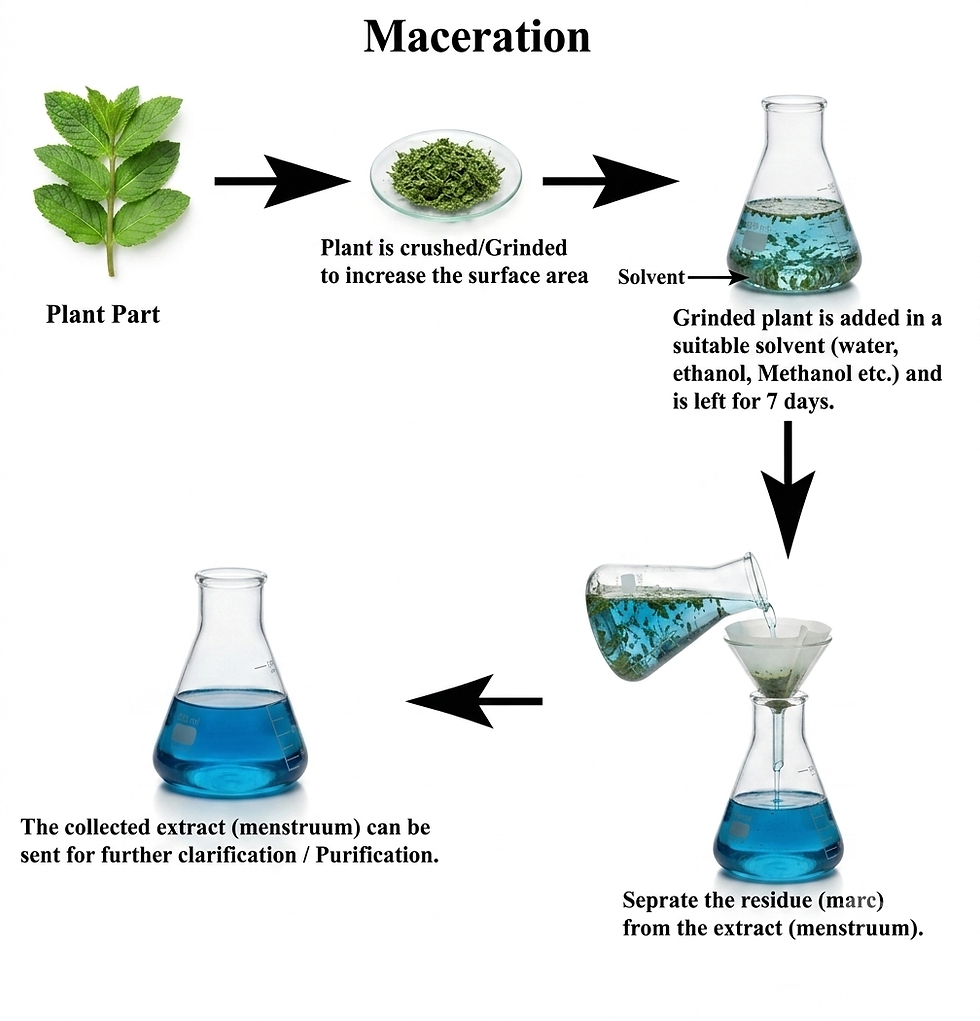
Maceration works on much the same principle as hot enfleurage, so much so that the two terms are often used interchangeably for flowers like rose, cassie, and orange blossom that can handle a bit of warmth. Rather than laying petals on a solid, waxed surface, though, maceration submerges the plant material directly in a liquid, warmed fat or oil, sometimes alcohol, and lets it steep for a set period before straining out the spent material and repeating with a fresh batch, again and again, until the base is saturated with fragrance.
Outside that strict, historical Grasse definition, the word maceration is also used far more broadly today to describe simply soaking any botanical material, leaves, bark, resin, spice, in oil or alcohol at room or gently warmed temperature until its aromatic compounds dissolve into the liquid. Vanilla pods, tonka beans, oakmoss, and benzoin are routinely handled this way to produce tinctures used directly in perfume compositions, and the same basic idea is behind most infused culinary and cosmetic oils, whether or not a flower is involved at all.
Resin tapping, harvesting a scent the tree makes on its own
Not every raw material starts life as a flower or a peel. Some of the oldest and most valuable ingredients in perfumery, frankincense, myrrh, benzoin, labdanum, are resins, and resins have to be collected before any distillation or solvent extraction can even begin.
The method is called tapping, and it's essentially the same idea across every resin-bearing tree or shrub: a harvester makes a shallow incision in the bark, and the tree responds the way any wounded plant would, by sealing the injury with a sticky sap. That sap oozes out, meets the air, and hardens over one to several weeks into small globules known as tears, which are then scraped off by hand and collected. Frankincense, tapped from Boswellia trees across Oman, Yemen, Somalia, and parts of India, is usually harvested in two or three rounds a season, with the very first exudate from a fresh cut often discarded since it tends to be dirtier, and later rounds prized as clearer and more fragrant. Myrrh, from the related Commiphora tree, tends to ooze more readily on its own, sometimes even seeping from natural cracks in the bark without much help at all.
Tapping isn't harmless to the tree, and how it's done matters. Researchers studying frankincense harvesting generally recommend no more than about a dozen incisions per tree per season, with several years of rest between tapping cycles, though fieldwork in some regions has documented trees cut well over a hundred times in a single season, a pace that leaves them vulnerable to disease and struggling to recover. It's a genuine concern for an ingredient that can take a decade or more to reach tappable maturity in the first place.
Once collected, the raw resin tears are sorted by grade and handed off to exactly the same processes covered earlier in this piece. Steam distillation pulls out a true essential oil, leaving the heavier resin acids behind, while solvent extraction produces the thicker, more rounded resinoid that perfumers rely on for warmth and fixation in a finished blend. Either way, tapping is only ever the first step: a raw material harvested directly from a living tree, long before anything resembling a still or a solvent tank enters the picture.
Supercritical CO2, the newest technique
The most recent addition to the toolkit uses carbon dioxide instead of a chemical solvent. Push CO2 past about 73.8 bars of pressure and roughly 88°F, and it stops behaving like a gas or a liquid in the usual sense; it becomes a supercritical fluid with genuinely useful solvent properties. Because the extraction happens at low temperature, the resulting absolute tends to hold onto the raw material's true scent unusually well, and since no chemical solvent is left behind or released into the environment, the process is clean by design rather than by cleanup.

Why the price tag rarely matches the effort
It would be reasonable to assume that oils requiring enormous amounts of raw plant material simply cost more to make, but the economics don't actually work that way. Magnolia flower oil sold for around $935 a kilogram at 2011 prices, compared with roughly $115 a kilogram for lavender oil, even though producing a kilogram of magnolia oil takes more than 250 times as many flowers as lavender does. The gap makes more sense once you factor in that lavender is harvested mechanically and yields far more oil per plant. In the end, what really sets the price of an essential oil isn't the labor that goes into extracting it. It's demand.
Sources
Ellena, Jean-Claude. Perfume: The Alchemy of Scent. Arcade Publishing, 2011.
Deg-Bhapka and Kannauj attar-making:
National Geographic, "This ancient city is the perfume capital of India" nationalgeographic.com/travel/article/how-did-kannauj-become-a-perfume-capital
Kannauj Attar, "Traditional Method of Making Attars Using Hydrodistillation (Deg & Bhapka Method)" kannaujattar.com/traditional-method-of-making-attars-using-hydrodistillation-deg-bhapka-method
Scento, "Guide to Indian Attars: History and Modern Use" scento.com/blog/guide-indian-attars-history-modern-use
About Amazon, "From Kannauj to your home, here's a peek into the intricate process of making Attar perfumes at Boond Fragrance" aboutamazon.in/news/small-business/know-how-indian-attar-perfume-is-made
Outlook Traveller, "Kannauj's Mitti Attar: The Scent Of Rain" outlooktraveller.com/experiences/heritage/petrichor-in-a-bottle
ThePrint, "Does GI tag bring more business? Mysore silk & Jardalu mango, not Kannauj attar" theprint.in/ground-reports/does-gi-tag-bring-more-business-mysore-silk-jardalu-mango-rose-not-kannauj-attar/2217748
Wikipedia, "Kannauj Perfume" en.wikipedia.org/wiki/Kannauj_Perfume
Expression and cold pressing:
"Extraction Methods of Natural Essential Oils," ResearchGate researchgate.net/publication/313638030_EXTRACTION_METHODS_OF_NATURAL_ESSENTIAL_OILS
Delacourte, "Expression in Perfumery: Cold Extraction & Citrus Oils" blog.delacourte.com/en/expression
Gadoi, "Cold pressing of citrus peels" gadoi.it/en/cold-pressing-of-citrus-peels
National Association for Holistic Aromatherapy, "Aromatherapy Extracts Produced from Plants" naha.org/explore-aromatherapy/about-aromatherapy/aromatherapy-extracts-produced-from-plants
Volatile solvent extraction, concretes, absolutes, and resinoids:
Wikipedia, "Absolute (perfumery)" en.wikipedia.org/wiki/Absolute_(perfumery)
Wikipedia, "Concrete (perfumery)" en.wikipedia.org/wiki/Concrete_(perfumery)
Wikipedia, "Resinoid" en.wikipedia.com/wiki/Resinoid
Enfleurage and maceration:
Delacourte, "Enfleurage: Traditional Cold and Hot Extraction Technique" blog.delacourte.com/en/enfleurage
Wikipedia, "Enfleurage" en.wikipedia.org/wiki/Enfleurage
Premiere Peau, "Enfleurage: The Near-Extinct Art of Capturing Scent" premierepeau.com/blogs/news/enfleurage-the-near-extinct-art-of-capturing-scent-pp
Bon Parfumeur, "Making a perfume by enfleurage" bonparfumeur.com/en-us/blogs/journal/enfleurage-in-the-perfume-making
Resin tapping:
National Geographic, "Frankincense trees, of biblical lore, are being tapped out for essential oils" nationalgeographic.com/animals/article/frankincense-trees-declining-overtapping
House of Frankincense, "Tapping Frankincense" houseoffrankincense.com/blog/2023/6/14/tapping-frankincense
ScienceInsights, "What Is Frankincense and Myrrh? Benefits and Uses" scienceinsights.org/what-is-frankincense-and-myrrh-benefits-and-uses

Comments